Wednesday, 25 July 2012

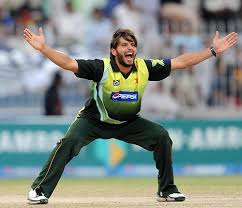
Shahid Afridi

Shahid Afridi Biography
Sahibzada Mohammad Shahid Khan Afridi was born on 1 March 1980 in Khyber Agency of the Federally Administered Tribal Areas, Pakistan, popularly known as Shahid Afridi, is a Pakistani cricketer and current One Day International (ODI) and Twenty20 captain of the Pakistani national team in the international circuit. He made his ODI debut on 2 October 1996 against Kenya and his Test debut on 22 October 1998 against Australia.
Afridi is from the Afridi tribe of the Khyber Agency in the Federally Administered Tribal Areas and hails from a Pashtun family. He is married and has two daughters, Aqsa and Ansha.
He is known for his aggressive batting style, and holds the record for the fastest ODI century which he made in his first international innings, as well as scoring 32 runs in a single over, the second highest scoring over ever in an ODI. He also holds the distinction of having hit the most number of sixes in the history of ODI cricket. Afridi considers himself a better bowler than batsman, and has taken 48 Test wickets and over 300 in ODIs. Currently Afridi is the leading wicket taker in the Twenty20 format taking 53 wickets from 41 matches.
In June 2009 Afridi took over the Twenty20 captaincy from Younus Khan, and was later appointed ODI captain for the 2010 Asia Cup. In his first match as ODI captain against Sri Lanka he scored a century however Pakistan still lost by 16 runs. He then also took over the Test captaincy but resigned after one match in charge citing lack of form and ability to play Test cricket; at the same time he announced his retirement from Tests. He retained the captaincy in limited-overs form of the game and led the team in the 2011 World Cup.
His general style of batting is very aggressive and attack oriented and has earned him the nickname “Boom Boom Afridi”. Moreover, out of the six fastest ODI centuries of all time, Afridi has produced three of them. As of 27 February 2011, he has an ODI strike rate of 113.83 runs per 100 balls, the third highest in the game’s history. This attitude has been transferred to Test cricket as well, with Afridi scoring at a relatively high strike rate of 86.13. He has an approach to batting that can change the tempo of a game and inspire the mood of an audience, as shown when a mass exodus of spectators occurred in Pakistan in late 2005 following his dismissal from the crease.
Having started as a fast bowler, Afridi decided to start bowling spin after someone told him he was throwing. He modelled himself on Pakistan leg-spinner Abdul Qadir. Afridi began his career as primarily a bowler, however after scoring the fastest century in his maiden ODI innings more was expected of him with the bat. He considers himself a better bowler than batsman. While he is renowned for his aggressive batting, he is also a handy leg-spinner capable of producing a good mix of wicket taking balls.
He has over 300 International wickets, most of which are from the ODI format. While his stock ball is the leg break, his armoury also includes the conventional off break and a ‘quicker one’ which he can deliver in the style of a medium-pacer. He bowls at a high speed for a spinner, resulting in lesser turn, and relying more on variations in speed. He occasionally sends down a bouncer to a batsman, which is very rare for a spin bowler.
Shahid Afridi
Shahid Afridi
Shahid Afridi
Shahid Afridi
Shahid Afridi
Shahid Afridi
Shahid Afridi
Shahid Afridi
Shahid Afridi
Shahid Afridi Great Best 30 Sixes In ODI
Shahid Afridi Makes 32 Runs From 1 Over Vs Sri Lanka

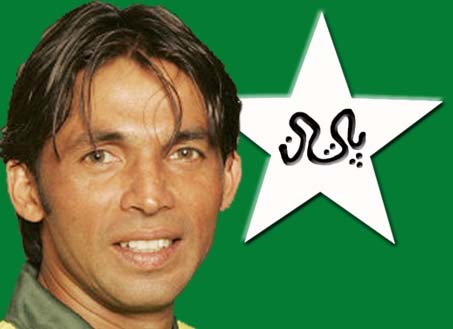
Shoaib Akhter

Shoaib Akhter Biography
Shoaib Akhtar is a former professional cricketer who played testes and One Day International matches for the Pakistan national team in ICC organized events. He has been dubbed as The Rawalpindi Express after the place where he was born and he is arguably the fastest bowler the world of cricket has ever seen, easily clocking 150 km/hour on many occasions. He became the first man to bowl a delivery over 100 miles/hour or 161.3 km/hour, which is the fastest delivery ever bowled in the history of cricket against England. Moreover, not only did he achieve a speed of 100 miles/hour on his delivery, he achieved it twice during one single match and that is something that makes him very unique in the world of fast bowlers. His prowess lay in being able to bowl fast and precise Yorkers as well as quick bouncers and these abilities made him one of the greatest as well as most feared bowlers of all time, the likes of which had not been seen in international cricket since the times of Michael Holding, Joel Garner, Jeff Thompson, Dennis Lillie, Malcolm Marshall and the likes – players who depended on raw pace to pick up wickets.
However, Shoaib Akhtar was also a very controversial figure and it followed him wherever he went. It has been said that he was very selfish and not a team man. The Pakistan team management once sent him home from Australia in the middle of a series because of an alleged poor behavior on his part. In 2006, he was perhaps involved in the biggest controversy when WADA found Shoaib Akhtar guilty of taking performance enhancing drugs and the ICC banned him from playing cricket. This ban was however lifted and he returned to the Pakistan national side the following year and almost immediately, got himself banned by the Pakistan Cricket Board or the PCB for fighting with team mate and fellow opening bowler Mohammad Asif during a training session.
He was selected to play for the Kolkata Knight Riders for the inaugural IPL but injuries blighted his season and he played only a handful of matches. Akhtar was so injury prone that he only managed to play a total of 46 tests and 163 One Day Internationals in his 12 year international career, taking a total of 425 wickets in all. Shoaib Akhtar, in spite of all his short comings, is truly a legend of the game and no matter what happens, cricket will always remember this flamboyant star.
Shoaib  Akhter 
Shoaib  Akhter 
Shoaib  Akhter 
Shoaib  Akhter 
Shoaib  Akhter 
Shoaib  Akhter 
Shoaib  Akhter 
Shoaib  Akhter 
Shoaib  Akhter 
Shoaib Akhtar At His Best
Shoaib Akhtar: The Fastest Bowler Of All Time. Pakistan

Shoaib Malik

Shoaib Malik Biography
Shoaib Malik (born 1 February 1982 in Sialkot) is a Pakistan cricketer. He made his One-Day International debut in 1999 against the West Indies and his Test debut in 2001 against Bangladesh. He started his career as just an off spinner, and is now regarded as a useful bowling all-rounder with a batting average in the mid 30s in both Test and ODI cricket. Malik is regarded as a flexible player. He is capable of hitting big shots but is also capable of rotating the strike with good placement. He has a strike rate of 77.23 runs per 100 balls, which compares favourably to players such as Rahul Dravid and Inzamam ul-Haq. His most brazen display of \”power hitting\” came in 2003 against South Africa when he scored 82 from 41 balls. As is required of most modern players he also has displayed good defensive batting at times. He has taken over 100 ODI wickets at an average under 35 and economy rate below 4.5. His bowling action has come under scrutiny (particularly his doosra) but he has had elbow surgery to correct this. In Tests, he has a better batting average against Sri Lanka and South Africa than other nations. In ODIs he has a better batting average against India, South Africa, and the West Indies than his overall career average. During his Test career, Malik has batted at 5 different positions and he has the unusual record of batting at every position except 11th in ODIs. Pakistan’s problems in finding a reliable opening pair have led to Malik being used as an opener in Test and ODI matches.
Shoaib Malik
Shoaib Malik
Shoaib Malik
Shoaib Malik
Shoaib Malik
Shoaib Malik
Shoaib Malik
Shoaib Malik
Shoaib Malik
Shoaib Malik 125 Vs India 2008 Asia Cup
Shoaib Malik & Sania Mirza Was Present At UEFA Champions League.Wmv

Muhammad Asif

Muhammad Asif Biography
Mohammad Asif (Urdu: محمد آصف) (born 20 December 1982 in Sheikhupura) is a Pakistani cricketer. He is primarily a right-arm fast-medium bowler. Early in his career he was compared to the Australian fast bowler Glenn McGrath, known for extreme accuracy. Asif has played for Khan Research Labs, the National Bank Quetta, Sheikhupura, Sialkot and Leicestershire. He made his Test match debut against Australia in January 2005. In 2006 there was controversy over Asif after he originally tested positive for a banned anabolic steroid, Nandralone, before having a ban imposed on him overturned on appeal. He was later withdrawn from Pakistan's World Cup squad with an unrelated injury. Further controversy followed when he was detained in Dubai suspected of having drugs on his person and was then found to have tested positive for a banned substance during the Indian Premier League.
Muhammad Asif 
Muhammad Asif 
Muhammad Asif 
Muhammad Asif 
Muhammad Asif 
Muhammad Asif 
Muhammad Asif 
Muhammad Asif 
Muhammad Asif 

Muhammad Asif Destroys Indian Batting

Mohammad Asif Wickets

Waqar Younis

Waqar Younis Biography
Waqar Younis Maitla (born November 16, 1971) is a famous Pakistani cricketer from Burewala, Punjab, and one of the greatest bowlers the game has known. He attended Pakistani College, Sharjah and Government College, Vehari. Playing as a fast bowler, he took 373 Test wickets and 416 wickets in One-day Internationals. He debuted for Pakistan against India on November 15, 1989. It is noteworthy that Sachin Tendulkar debuted in the same match. His most lethal weapon was the in-swinging yorker, which he managed to produce at will and with a high degree of accuracy, as experienced first-hand by plenty of county batsmen who were unfortunate enough to face him at his peak.
Known as the "Burewala Bombshell", Waqar formed one half of the legendary fast bowling partnership with Wasim Akram. At his peak, most were of the view that there was no better bowler, especially with regards to wicket-taking ability and being penetrative. His tendency to aim for the stumps earned him the highest strike rate of all time, among the bowlers with 200 or more wickets. His blistering pace and toe-crushing yorkers put tremendous fear in the batsmen. Much was expected of him but he stayed out of the team for quite a long time to do his talents and fans justice because of his controversial conflicts with once bowling partner and captain Wasim Akram. His comeback, however, came with him being appointed the Captain of the national side - which he remained so till his side failed to make an impact in the 2003 World Cup. He was forced to retire as the Pakistan Cricket Board persistently ignored him for national selection.
Waqar was one of a long line of Pakistanis (starting with Safraz Nawaz) who mastered the art of reverse swing. It was his partnership with Wasim Akram that took this art to new levels, and their 1992 series versus England will forever be remembered as their signature series. Many sections of the English media could not fathom how an old ball could swing so much and so late, and this led to cries of foul play and the infamous allegations of "ball-tampering" from some quarteres. The passage of time, coupled with the fact that England now have their own reverse swing bowlers, has led to an appreciation of the science and skill behind reverse swing, and most now accept that Waqar was simply ahead of his time.
Waqar Younis is cited alongside Wasim Akram, Allan Donald, Glenn McGrath, Walsh and Ambrose as the best fast bowler of the 90s. While his contemporaries, Donald and McGrath, played most of their cricket on the fast and bouncy tracks of South Africa and Australia, backed up by the spectacular fielding sides, Waqar Younis, on the other hand, had to contend with the slow and docile tracks of the sub-continent, backed by a fielding side that had nothing so distinguished to write about. An astonishing number of Waqar's wickets have been clean bowled or have come from leg-before decisions showing how much he has had to depend on his own efforts to get his batsmen. He will be known for his attacking bowling as against the "line n' length" bowling of the most of his peers. He bowled one of his best balls to Brian Lara, another cricketing legend, which ended with Lara on the ground, his stump flipped 6 feet away. Waqar Younis has some outstanding records. He is the only bowler who has taken 5 wicket haul in 3 consecutive ODIs. He has taken 4+ wickets on 27 occasions in ODIs, which is a record. He has also taken the fastest 50, 300, 350 and 400 wickets in ODI matches and in test matches he has taken the fastest 150, 200, 250, 300, 350 wickets by lesser number of balls bowled.
Although primarily a bowler, Waqar hit 1010 Test runs; he is in fact (as of September 2005) the only man to pass the thousand mark without ever scoring a fifty. He is now married with a son and a daughter. Recently, he has become a television cricket commentator for Australia's Nine Network since a series against Australia and Pakistan.
Waqar Younis
Waqar Younis
Waqar Younis
Waqar Younis
Waqar Younis
Waqar Younis
Waqar Younis
Waqar Younis
Waqar Younis
WAQAR YOUNIS- THE REVERSE SWING KING!
Waqar Younis Stunning Yorkers

Salman Butt

Salman Butt Biography
 Salman Butt, a Pakistani batsman, was born on October 7, 1984 in Lahore. He opens the batting in both Test and One Day Internationals (ODI). He is a hard working batsman, who does not indulge in many big hits. He is well-known for his wristy strokes and employs superb wristwork to angle the bat and guide the ball into gaps. Being an accumulator, Salman Butt scores most of his runs between backward point and extra cover, and he also has the ability to cut the ball very fine, down to third man.
Salman Butt started his cricketing career by playing for the Pakistan Under-17 national team, and soon progressed to Under-19 level. He secured a place in the Pakistan A squad for the match against England when he was only 16 due to his performance in his first match for Lahore Whites. He made his first international Test appearance in a match against Bangladesh on September 3, 2003 in Multan. He made his presence felt in the Test series against England in 2005 by scoring a century and two half-centuries. As of June 2008 he has played a total of 19 Tests and has scored 1047 runs, his highest score being 122.
On September 22, 2004 Salman Butt made his ODI debut in a match against West Indies in Southampton at the International Cricket Council (ICC) Champions Trophy. His first ODI half-century came in a match against Sri Lanka at the Paktel Cup. On November 13, 2004 in a match against India, Salman Butt inspired Pakistan to victory by scoring an unbeaten 108, despite having to miss seven overs due to cramps. He has played 57 ODIs and has amassed 2154 runs, his highest being 136 as of June 2008.
Salman Butt made his International Twenty20 (IT20) debut against Bangladesh in Nairobi on September 2, 2007 and has played eight IT20 matches as of 2008.
Salman Butt has played a total of 66 First-class and 112 List-A matches, his best being 290 and 136, respectively. He played his first Twenty20 match at the domestic level on April 26, 2005, against Sialkot Stallions, and has played a total of twenty four Twenty20 matches.
Owing to his performances, Salman Butt was included in the Kolkata Knight Riders team at the 2008 Indian Premier League (IPL) and played seven matches for the team, scoring 193 runs at a strike rate of 119.87, his highest being 73 scored against Chennai Super Kings.
Salman Butt 
Salman Butt 
Salman Butt 
Salman Butt 
Salman Butt 
Salman Butt 
Salman Butt 
Salman Butt 
Salman Butt 
Salman Butt 72 vs AustraliaIst Odi Jan 2010
Salman Butt 101 Vs India.Mp4

Muhammad Younis Khan

Muhammad Younis Khan Biography
Mohammad Younis Khan (born November 29, 1977 in Mardan, North-West Frontier Province, Pakistan) is a Pakistani cricketer and current captain of the Pakistan national cricket team. Younis' name is often spelled Younus Khan.He is only the third Pakistani player to score 300 or more runs in an innings. Younis Khan made his international debut in an ODI against Sri Lanka at Karachi in February 2000, and has since played over 150 ODIs for Pakistan. He has also played in over 50 Test matches. Younis was one of the few batsmen who retained his place in the team after Pakistan's disastrous World Cup campaign in 2003, but lost it soon after due to a string of poor scores in the home series against Bangladesh and South Africa. He came back for the one-day series against India, but failed to cement a place in the Test side. It was his return to the side in October 2004, at the pivotal one-down, against Sri Lanka in Karachi that laid the groundwork for his emergence as a force in Pakistan cricket. He was the top run-getter in the disastrous 3-0 whitewash in Australia immediately after and on the tour of India, for which Younis was elevated to vice-captain, he blossomed. After a horror start to the series he came back strongly, capping things off with 267 in the final Test. It was his highest Test score and came off 504 balls in the first innings, to set up a series levelling victory in Bangalore. As well as being an accomplished batsman, Younis is also a skilled slip fielder and a very occasional leg-spin bowler. He has performed particularly well outside Pakistan, including on tours of Australia, India, England and Sri Lanka. In the six Tests he has played against India, Younis averages an exceptional 106, the highest average against India by a Pakistani. Apart from his 267 at Bangalore, Younis also made 147 at Kolkata in 2005 and a pair of centuries during India's trip to Pakistan in 2006. More importantly, the tour to India also showcased his potential as a future captain of Pakistan and his energetic and astute leadership has impressed many people. Also in 2006, Younis made a century in the third Test against England at Headingley. On 22 January 2007, he scored a matchwinning 67 not out in the 4th innings to guide Pakistan to victory over South Africa in Port Elizabeth. The five wicket win levelled the series at 1-1. In 2005, he was one of the 15 nominees for the ICC Test Player of the Year. He is the second fastest Pakistani in terms of innings to reach 4000 Test runs, behind Javed Miandad. Younis reached the milestone in 87 innings, just one more than Sachin Tendulkar took. Younis Khan's highest position in the LG ICC's Test Batting Rankings is third, which he achieved after the third test against England in 2006. His ranking score of 856 is the fourth highest achieved by a Pakistani batsmen after Mohammad Yousuf (933), Javed Miandad (885) and Inzamam-ul-Haq (870). Younis Khan made his first 300 against Sirilanka in 24 Feb 2009.
Younis Khan Profile:
A middle-order batsman, Younis Khan is fearless, as befits his Pathan ancestry. He plays with a flourish and is especially strong in the arc from backward point to extra cover. He is prone to getting down on one knee and driving extravagantly. But this flamboyance is coupled with grit. His main weaknesses are playing away from the body and leaving straight balls. Younis was one of the few batsmen who retained his place in the team after Pakistan's disastrous World Cup campaign in 2003, but lost it soon after due to a string of poor scores in the home series against Bangladesh and South Africa. He came back for the one-day series against India, but failed to cement a place in the Test side. He is among the better fielders in Pakistan and he took a world-record four catches in one innings as substitute during Pakistan's demolition of Bangladesh in the 2001-02 Asian Test Championship. He displayed further versatility by keeping and winning the Man of the Match award against Zimbabwe in the Paktel Cup. But it was his return to the side in October 2004, at the pivotal one-down, against Sri Lanka in Karachi that laid the groundwork for his emergence as a force in Pakistan cricket. He was the top run-getter in the disastrous 3-0 whitewash in Australia immediately after and on the tour of India, for which Younis was elevated to vice-captain, he blossomed. After a horror start to the series he came back strongly, capping things off with a matchwinning 267 in the final Test. Since then, barring minor troughs such as the 2005-06 series against England at home, his career has been one elongated peak, scoring hundreds against India and England for fun and becoming Pakistan's most successful one-down in recent memory. More importantly, the tour to India also showcased his potential as a future captain of Pakistan and his energetic and astute leadership has impressed many people. As captain in Inzamam's absence he led the side to a disastrous loss against the West Indies in 2005 but also to a memorable win against India in Karachi in January 2006. Halfway through 2006, and for the first time in many a year, Pakistan have a plan of succession for the leadership. And also a very good one-down.
Major Team: Pakistan, Habib Bank Limited, Nottinghamshire, Peshawar Cricket Association, Rajasthan Royals, South Australia, Surrey, Warwickshire, Yorkshire
Playing Roll: Batsman
Batting Style: Right
Bowling Style: Right-arm medium, Legbreak
Nick Name: Younus Khan
Major teams Pakistan, Habib Bank Limited, Nottinghamshire, Peshawar Cricket Association, Rajasthan Royals, South Australia, Surrey, Warwickshire, Yorkshire.
Younis Khan is fearless, as befits his Pathan ancestry and will forever be remembered as the second Khan to bring home a world title for Pakistan: Younis was Pakistan's captain in the 2009 World Twenty20, leading a successful campaign with stark similarities to the one Imran Khan had led 17 years earlier. Younis retired from the format straight after, a graceful and dignified gesture from a complex but honest man.
Muhammad Younis Khan
Younis Khan Doing Bowling Vs Sri
RARE YOUNIS KHAN BOWLING